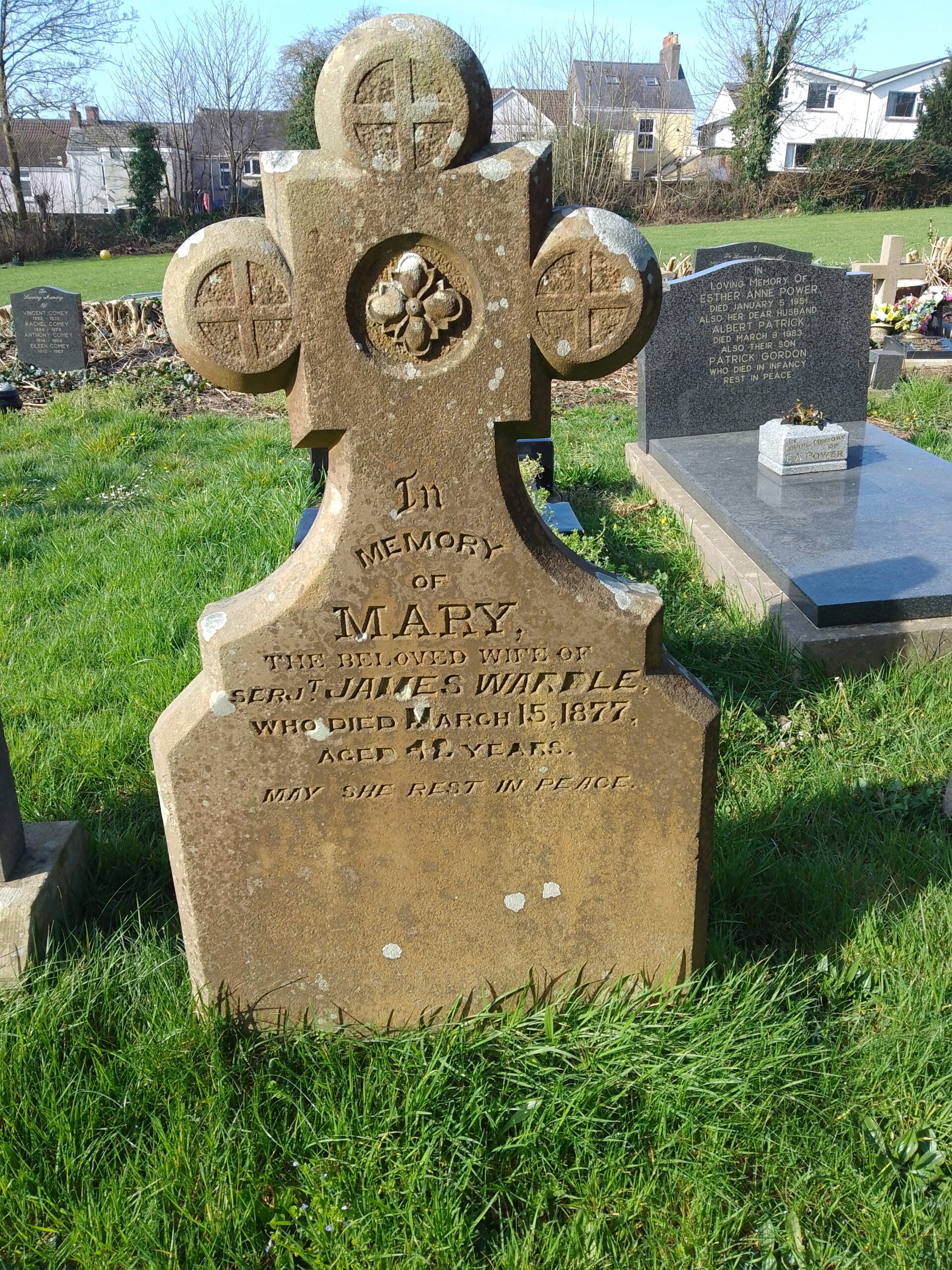
The information below is a “follow up” of the complicated story of James Wardle as previously published. Whilst “Part 1 ” of the story concluded with some brief details of the inquest report this final segment enlarges on that report in some detail. What was not generally known however was that James had married previously and her name was MARY. She was buried in St Mary’s Roman Catholic Church Cemetery in Union Street Carmarthen – a mere stone’s throw from St Davids- the next street in fact. A photograph of the headstone can be seen below. It also appears from the research I have carried out that there was some concern shown by the Coroner as to the cause of death and this could have been attributed to his second wife Margaret having a very nasty temperament. She is in fact mentioned several times in the local papers as having been brought to court for a number of offences including affray and assault by beating. Little wonder then that James’s son by his first marriage took a great dislike to her as can be seen in the report highlighted below.
Here then is the final instalment of James’s story. May he rest in peace.
Sergeant James Wardle ( Part 2 ) Veteran of the Crimean War and Indian Mutiny who re married after the death of his first wife Mary but never recovered from the trauma of his experiences in India and Russia.
Death of Sergeant Wardle. DOCTOR REFUSES TO CERTIFY. INQUEST AT THE KING’S ARMS, PRIORY- STREET. An inquest was held at the King’s Anns. Priory street, Carmarthen, on Tuesday, at 7pm before Mr Thos. Walters (coroner for the borough), touching on the death of James Wardle, Richmond Terrace who had formerly been on the permanent staff of the Carmarthen Royal Artillery. John Wardle, the son of the deceased, who lives in Little Water-street, a plumber said I did not see my father during his illness until last night, about 8.15 p.m. I had not seen him for a fortnight before that. I knew that he was not well -not up to the mark. On Wednesday fortnight he was rather ill, and complained of the shivers over him he said there was something the matter with his head. He saw people in front of him, and wanted me to drive them away. I saw him in this house on tho previous Tuesday when I went down to the house with him he showed me a bleeding cut on tho side cheek. He told me he did not know where he got it. This was about half past six in the evening, he was not exactly sober then. I do not know how long he had been there that day. I took him to my house: He remained at my house until Wednesday night. He had a house of his own I do not know why be remained with me. He wanted to go home so I took him home. He said that he would stop with me on Tuesday night he gave me no reason for so doing. He had not stayed at my house before I never asked him why he wanted to stay with me I could not make out why he had come to have his face all covered with blood. I am married I was about my work on Wednesday. I left my house on Wednesday between half-past six and seven o’clock to take him home. He asked me three times while I was at tea to take him home. I said, “all right.” I asked him both here and at my house where he had got the wound over the right cheek he said he did not know. I did not ask anyone here how he had received it. I asked up in Waundew and they told me that he had fallen down on Tuesday morning, after coming out of the house of Mrs Thomas. It was yesterday I was told that. They did not tell me why he fell, neither did I ask. They said he fell down right on his face as he shouted out. I should think he had been drinking by the look of his face. It was Mrs Thomas who asked for me to come up here. He was living happily with his wife. When I took him home on Tuesday night, I did not tell his wife. She and I are not very friendly and I keep away from her. He was quite sober when I took him to his own house. He did not complain to me of his treatment at home. The Coroner said that he asked these questions in justice to Mrs Wardle. If these matters were gone into at a public enquiry, there would be no need for people to talk afterwards. Witness, continuing, said “so far as I knew the deceased and his wife lived happily together”. I left them about fifteen months ago. I never saw him so bad with drink as he was on the Saturday of the fair. Margaret Wardle the widow said “It is going on sixteen years since I was married to the deceased. During that time we lived fairly happily together. I had never seen him take to drink so bad as the day he fell. He told me he met some traveller; he said he did not remember where he had been. He had been out all night on Monday. I last saw him on Monday, between 6pm and 7 p.m. He was not very sober .When he went out; he had had a few pints. I saw him next morning, between 10 and 11o’clock. He was all bleeding.” He came in with Miss Thomas, the bakehouse, and another young man, he said he remembered falling on a stone by Mrs Thomas’s, who is a neighbour; he said he did not remember where he spent the night. He had some dinner, and then went out about 2 p.m, I asked him where he was going he said he was going out-, and that, he did not know where he was going, I tried hard to pursuade him to remain but he went. He had a mutton chop and one potato to eat. I heard that he had come here; he used to come back in a short time. I was told that he had gone with Johnnie, his son. I knew where he was. I came home after him at 7 p.m., but he had gone. I did not go after him; I knew he would be safe in Johnnie’s house. I did not go to see him on Wednesday, to let him have a rest to get sober, I fetched a doctor on Friday, I had been bathing his head before, and he said he would not have a doctor. The doctor (Dr R G Price) left him some medication and powders. He told us on Monday that he was getting better. He came downstairs about 7.15 p.m and had his gruel as usual in the chair. He never missed a meal during the whole time he was in bed. He turned white and complained a little, as if he was fainting. I sent someone to fetch the doctor and Johnnie. We put him back to bed, and he spoke and knew both Mrs Thomas and the daughter. He then got up and sat in the chair a second time, he was there when Johnnie came. He spoke twice to Johnnie during that time then he had a second fit, and died in about ten minutes. Dr C. P. Parry spoke to making a post mortem on the deceased, in conjunction with Dr R G Price. They found large haemorrhage on the left side of the brain, about four inches along the back and front. The brain was very much coagulated and soft; there was no evidence of fracture. There was a little external scratch, but no other mark of violence. Death was probably due to rupture of a blood vessel this might be due to natural causes the result of an evacuation. The other organs were not examined, as the cause of had been ascertained. Death was quite consistent with the evidence which had been given. Dr. Price agreed with the evidence given by Dr Parry. He had attended deceased. He was unable to give a certificate, as he was not satisfied as to the cause of death. He was not satisfied whether the death was due to natural causes or to the accident. Deceased had been improving for the last few days but he had suffered a good deal of pain from the injury, more so than the external appearance would wish one to imagine. He showed symptoms of brain irritation during the whole of his illness. The pain was so severe that ho could not sleep. Witness had not attended the deceased or his family for many years; he had never seen deceased drunk—nor noticed any of the physical effects of drink on him, except the fall which was stated to be due to that cause he had no doubt, whatever, now as to death being due to natural causes. Witness had thought it would be advantageous in justice to everyone to have a public inquiry, for if deceased had been buried otherwise, ugly rumours might have got abroad. John Wardle, the son of the deceased, in answer to the Coroner, said that deceased was a pensioner, having served his 21 years in the Royal Artillery, and been through the Crimea War and the Indian Mutiny. He was 70 years of age, had lived 27 years in Carmarthen, and had a pension of 18 shillings a week. The Coroner, having summed up, the Jury returned a verdict of “Death from Natural Causes.”