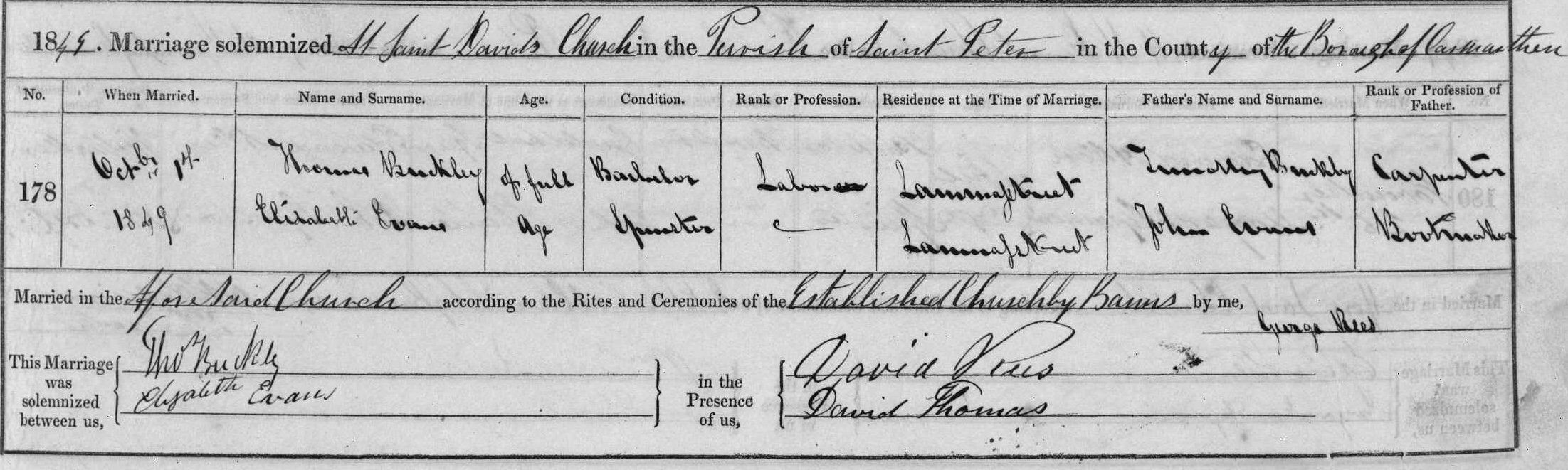
Thomas Buckley, an Irishman, married Elizabeth Evans, a Carmarthen girl, in St David’s Church on October 1st 1849 both living in Lammas Street at the time. Ellen Buckley their only daughter was born in 1853 and died on the 7th June 1854 of whooping cough aged one year old. She was buried in this cemetery – St David’s two days later, attended by many family and friends, her father carrying the coffin to it’s last resting place. There is no grave marker. Less than two years later on 19th July 1856 Ellen’s father – Thomas was also dead at the age of 35 from Tuberculosis brought on so sudden that only a month before he was giving evidence in Carmarthen Courthouse and four months previously to that, had became the proud father of a son also called Thomas. In August 1868 aged 12 he too also died.
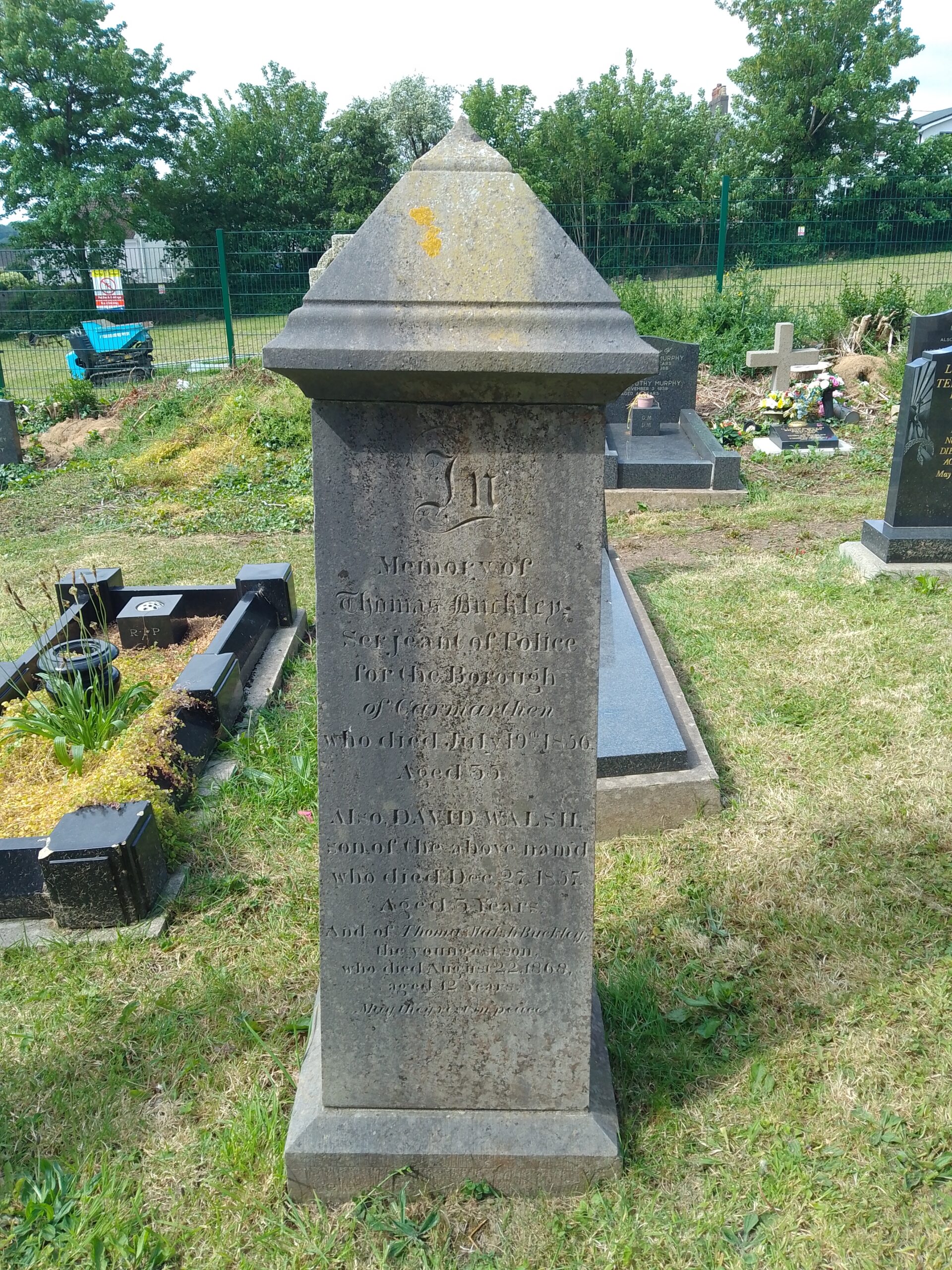
Both father and two sons were buried together in St Mary’s Catholic cemetery – a few minutes walk from St David’s. It is however of some great mystery as to why Ellen was buried in St David’s and not St Mary’s with her father and two brothers especially as the newly consecrated Church of St Mary’s had been open for at least two years before Ellen died. It may also be that Ellen had not yet been baptised due to her very young age meaning that she could not be accepted into the Catholic Church and be buried within it’s newly created cemetery. It is however sad to realise that by virtue of religious beliefs they became separated for all time.
Elizabeth herself- Ellen’s mother moved away from Carmarthen in later years, presumably to get away from all the trauma of her earlier life.
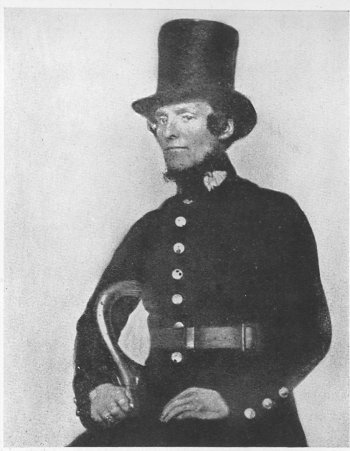
Ellen’s father Thomas was a truly remarkable individual and one that I have had great pleasure in researching.His marriage certificate states that in 1849 he was a Labourer so his entry into the Borough Police Force must have been in the early 1850’s. Every week in the Carmarthen Journal, and Welshman newspapers he would be found somewhere in print having apprehended, arrested, fought, and saved many lives, and, travelling across the country including London, in pursuit of the criminal fraternity. What follows is only a very small fraction of his exploits as a Police Constable and then Sergeant over a two year period. In truth there are hundreds of stories of his efforts to bring Carmarthen’s unruly and criminal fraternity to the courthouse and also many stories of him apprehending and arresting soldiers that had deserted, having a keen eye for the way they were dressed for example. Living in Lammas Street in the centre of Carmarthen as he did, he saw a great deal, being right in the thick of it when it comes to the number of Public Houses for example ( 140 PUBLIC HOUSES IN CARMARTHEN AT THE TIME ) and also arresting Anne Awbury for her 101st conviction for being drunk and disorderly. He was undoubtedly a real character that brought great credit to the local Borough Police Force for which he was recognised, credited, and thanked for several times, but as was the case so often during this period he was taken away so suddenly and prematurely by TB which manifested itself in days resulting in his sudden demise. Though he is not buried here in St David’s cemetery but in St Mary’s, I felt nevertheless compelled to write his story as his daughter Ellen would have wanted. Being married here in St David’s Church means he will always have an association with this place.Ellen’s father will always be her father after all wherever he is buried. God bless them all and may they rest in peace and rise in glory.
Carmarthen Town Council Meeting held on November 10th 1854. The Welshman and General Advertiser page 2
The Mayor felt bound to notice the conduct of Sergeant Thomas Buckley, who was an active and exceedingly efficient officer, steady, intelligent, and always at his post. Sergeant Buckley had rendered considerable services to the Town Surveyor as assistant Inspector of nuisances, and the town was now through their combined exertions in a very creditable sanitary condition.
The Welshman. June 30th 1854
APPOINTMENT OF POLICE SERGEANT. — On Friday last a Watch Committee was held in the Council Chamber, when there were present, the Mayor, Mr. C.Brigstocke, and Mr. S. Tardrew. Sergeant Davies sent in his resignation on the grounds ,of insufficient salary, and excessively heavy duties. The committee appointed P.C. Thos. Buckley to the vacated office, agreeing that he was one of the most active and efficient men in the force; sober, diligent, and particularly attentive to his duties.
March 14th 1856. The Welshman
ALLEGED EMBEZZLEMENT.—James Davison a foreman during the last six months in the employ of Mrs.Needle, tailor, Queen-street, recently decamped charged with having received, sums amounting to more £40 which he has not accounted for. The following announcement has appeared in the Police Gazette . “LARCENY AND EMBEZZLEMENT—The following is a description of James Davison, a tailor, who absconded on the 1st instant, from from the employment of Mrs Needle, Queen Street, Carmarthen, charged with Embezzlement. He is about 5 feet six or seven inches high 26 years of age and dark complexion and hair, large dark eyes, thin visage, long neck, broad shoulders and chest and a large hair curl on the top of his forehead; when he left he was dressed in a suit of black, his top coat having very long sleeves and his hat lined with cloth inside the brim. He is a member of the Wesleyans. Information to be given to the Borough Police Carmarthen. -Bow Street, March 12th 1856” The police of the Carmarthen Borough hesitate to go in pursuit of him, as, if they do not succeed in capturing him, they have to bear their own. expense, which they are not in a position to do. A subscription has been suggested to guarantee the expenses of P.S. Buckley in the event of failing to apprehend, but nothing has been done. The police have obtained a good deal of information which leads to the expectation that he will not long escape detection, and the punishment which systematic embezzlement, under the guise of religion thoroughly merits.
CHARGE OF STEALING ONE HUNDRED & THIRTY SOVEREIGNS AND TWO TITLE DEEDS. On Monday last, Evan Charles, was brought up in the custody of the police, before the Mayor, and E. H. Stacey, Esq., at the Town-hall, and charged with stealing one hundred and thirty sovereigns, and two title deeds, the property of his father John Charles, landlord of the Cross Keys, public house, Lammas Street. The peculiar circumstances of this case, excited considerable interest and during the examination the court was crowded to excess. Mr. R. A. Thomas, instructed by the prosecutor, conducted the case, and Mr. T. Parry, who was sent for at the request of the accused when the case had been partly heard watched the proceedings for the prisoner. John Charles examined I am the prisoner’s father and keep the Cross Keys, public house, in Lammas-street. The prisoner lived in the house with me. He is married and until Saturday morning his wife lived with him, when she went away on account of his continued ill usage. I believe she went home. It was when I got out from bed that I first knew she had gone away. She was my housekeeper. I then secured the services of a woman to conduct my business. About four o’clock in the afternoon as I was going down Lammas-street, I met William Evans of the Railway Tavern who after a little conversation, asked me if it was true that my daughter-in-law had decamped, plundering me of my money and deeds. I said that she had left but that my property was safe, having seen it in my box the previous night. The box I referred to was kept in my bedroom. There was a lock on it, of which I kept the key. No one had any right to go to it but myself. I saw it on Friday night and it was then safe. I had then one hundred sovereigns in a tin box and thirty sovereigns in a purse. I had some deeds relating to land in Picton Place, and houses in Pendre. It is freehold property. On my return to the house I went upstairs to my room, the door of which I had previously locked, and when I had locked myself in I tried to open the box. At first I experienced some difficulty, caused by the disorder produced in opening it with a false key. When I succeeded I found that my money and deeds had been removed. I then went down and informed those in the house that I had been robbed of all I possessed. I immediately gave information to Sergeant Buckley. I subsequently found that access was obtained into the room through the window, which had been left open, by means of a long ladder against the wall which had not been removed. Mr. Parry at this stage of the proceedings, by permission of the court retired with the prisoner, and on his return recommended that on account of the relationship between the prisoner and the prosecutor a compromise should be permitted, to which the court refused to accede. P.S. Thomas Buckley examined: “In consequence of information I received from the prosecutor, I pursued and apprehended the prisoner. When in the station house I searched him and found on his person the bag now produced. It contained ninety-five sovereigns, and was concealed at the back of his leg sustained by the string which tied his gaiter. I also found another bag which I now produce in his breeches pocket. It contained seventy-six sovereigns. In his pockets there were also 13s. in silver and copper. The private agreement I now produce was also upon him. In an outhouse of the Three Salmons public house Water-street, the two deeds now produced were found by me. Upon the cover of one of them is written “Deed belonging to Mr. John Charles.” The documents were concealed in the house. Howell Howell examined I am landlord of the Three Salmons public-house, Water-street. On Saturday morning last about breakfast time the prisoner came to my house and remained there some time. This morning- the deeds now produced were found on the premises concealed in the roof of an outhouse. This was the whole of the evidence, the prisoner having reserved his defence; and the usual caution having been read, he was committed to take his trial at the next Quarter Sessions for the borough.
The Welshman. October 6th 1854
SANITARY CONDITION OF THE TOWN.—The health of this town has been remarkably preserved during a trying period which has now nearly terminated. Whilst virulent epidemics and diseases have raged with fearful destruction in other places we have been mercifully protected. It was fortunate that early in the season our active Surveyor, with the assistance of P.S. Buckley, adopted all precautionary measures which suggested themselves. The improvement which has been effected under their superintendence is really surprising. Kidwelly fach formerly one of the filthiest and most unhealthy parts of the town has almost been renovated. The public sewer which has recently been constructed, affords a ready outlet to the matter which used to be allowed to accumulate into feculent heaps, and impregnate the atmosphere with noxious particles. The houses are, through the kindness of Mrs. Cross, Abermarlais, white washed, inside and externally, and now wear a clean and healthy appearance, while the senses are not offended with unsightly nuisances or poisonous effluvia. Every part of the town is now. very free from filth, a good protection from epidemic and diseases which are most immediately atributable to sanitary defects.
18th May 1855 page 5 The Welshman
On Monday, before William Morris, Esq. Mary Ann Thomas, a nymph du pave, was convicted on the evidence of P S Thomas Buckley, of drunkenness and breaking a pane of glass in a widow of a house in Friar’s Park, on the previous night at 12 o’clock. This was her twentieth conviction before the magistrates within a short period. Committed to prison for two months.
No date of publication.
CONCEALMENT OF THE BIRTH OF A CHILD.-On Wednesday last, an inquest was held in the Town Hall, before John Hughes, Esq., on the body of a new born child. The evidence is totally unfit for publication, but the simple facts of the case are these—Elizabeth Williams, a single young woman, residing at Llanddarog came to Carmarthen on Friday morning last, and went to the premises occupied by Methuselah Evans, in Chapel street, with some work for his granddaughter, who is a dressmaker. She was accustomed to take work to Elizabeth Evans, and when she did so remained until it was completed, assisting to sew. On Saturday she complained of being unwell, but refused to see any medical man, stating that it was useless as her pain arose from cholic to which she was subject. Several persons observing her appearance accused her of being enciente, but she stoutly denied it. She did not go to bed on Saturday night and on Sunday morning persons who occupy apartments in the house heard sounds emanating from the room she was in, resembling a person in excessive pain, but they saw nothing. On Monday morning she left the house and returned to Llanddarog in a cart. The alteration in her person excited suspicion, and on Tuesday afternoon Sergeant Buckley instituted a search on the premises, and found the dead body of a new born child in a cesspool, which he washed and conveyed to the station house. He then apprehended Elizabeth Williams, Mr. Rowlands, surgeon, made a post mortem examination of the body, and arrived at the conclusion that the child had never had an independent existence. The jury returned a verdict of “Found Dead.” There is reason to believe that the young woman had at least one accomplice, and as soon as she is sufficiently recovered an examination will be taken before the magistrates. (No date of publication)
CHARGE OF OBTAINING MONEY UNDER FALSE PRETENCES.– On Monday last, before E. H. Stacey, Esq., John Langton Leach, son of the Venerable Archdeacon Leach, Rector of Egremont, Cumberland, formerly Clerk to the Surveyor of the Post Office for the South Wales District, was brought up I in the custody of the police on a charge of having obtained money from Mr. Matthews, postmaster of this town, under fraudulent pretences. The prisoner is of dissipated habits, through which he lost a lucrative and promising situation. His personal appearance testified to the degrading influence of the life he has led, and excited the deepest commiseration. He was apprehended by Sergeant Buckley in a low house of ill fame at Oxford, and appeared to feel most acutely the position in which he was placed. The only witness was Mr. John Matthews, who on being examined said, I am the post- master residing at Carmarthen. I know the prisoner. He has been in the service of the General Post Office. He held a situation there in May last as Surveyor’s Clerk. He attended the post office here in that capacity. ( No date of publication )
THE POLICE FORCE.—A meeting of the Watch Committee was held on Friday last. There were present-the Mayor, Messrs. W, Morris, E. H. Stacey, Valentine Davis, George Davies, and Samuel Tardrew. A memorial from P.S. Thomas Buckley for an increase of salary and an alteration of duty, was laid before the committee, when, after a discussion, it was ordered to recommend that his salary be increased from 18s. to £1per week, and that, instead of continuing on duty every night from 10 until 6 o’clock, he shall go on duty at 9 o’clock and be relived at midnight by the first-class constable, and that he shall resume duty at 10 o’clock every morning. It was also determined to recommend the council to increase the pay of the first-class constable to 18s. instead of 17s. per week, and that the fees be divided exclusively between the ordinary men, whose salary is to remain the same as at present—16s. per week.
MELANCHOLY SUICIDE.
2ND NOVEMBER 1855 WELSHMAN
P.S. Thomas Buckley examined On Sunday morning “I went to the Weaver’s Arms in Water-street, where I saw deceased hanging from the head of the bedstead by a silk handkerchief. I immediately cut him down, but he was quite dead and cold. I now produce the handkerchief. I found ninepence in his pocket. There was no mark of violence on the body. He wore two pairs of breeches.” This was the whole of the evidence, and the coroner having briefly addressed the jury, a verdict of “Hanged himself when in a state of temporary insanity” was recorded.
LIGHT FINGERED GENTS.On Friday night P.S.Thomas Buckley ascertained that four suspicious looking persons in the guise of cattle dealers had arrived in this town by the last train from Narberth fair on the previous day. They played cards in the railway carriage evidently to attract attention, but they were recognised as questionable characters, frequently seen at cattle fairs. Buckley kept a careful watch during the night, but he failed to catch a glimpse of them. Determined that they should not secure any booty if it were possible to prevent them, instead of going off duty, Sergeant Buckley remained out during the whole of Saturday, a great portion of the time in plain clothes. In the afternoon he heard that Mrs. Thomas, of Guildhall square, had lost from her pocket five shillings, but as she could not identify the thief nor accurately describe him, there was no chance of detection, there being so many strangers in the town. However, from the imperfect description given, Buckley obtained some intelligence of his whereabouts,” and while in pursuit, he was informed that a Mrs. Henry had been robbed of five sovereigns, and that she distinctly saw the person who picked her pocket. From her he obtained additional particulars, and soon afterwards met “his man” in Water-street, and inquired of him where he was going. He replied that he was on his way to the Railway Station. Buckley walked along with him for a few seconds, and then requested that he would accompany him to the station-house, as there was a charge of felony against him. He refused to go with the Serjeant, and attempted to make an escape, but as he was quickly “slipped,” he had no alternative, and was compelled to go to the station-house. On being searched five sovereigns and a half in gold were found in his possession. When questioned by Buckley he said he was a cattle dealer from Cardiff, and having purchased two ponies in the fair he had sent them off, but he refused to tell where he paid for them, and of whom he bought them. He stated that he knew several cattle dealers— a Mr. Johnson, of this town, (there being no such person) and two big fat men’ whose names he could not remember.
22ND JUNE 1855 PAGE 5 THE WELSHMAN
CARMARTHEN POLICE COURT.-In the Town Hall, on Friday last, before the Mayor and E. H. Stacey, Esquire. Ann Awbrey was convicted of drunkenness and disorderly conduct, on the evidence of P.S. Thomas Buckley. This was the hundred and first time she had been similarly convicted. She was again committed to prison for three months.
7th September 1855 page 3 The Welshman
Headstone Inscription
IN
MEMORY OF
THOMAS BUCKLEY
SERGEANT OF POLICE
FOR THE BOROUGH
OF CARMARTHEN
WHO DIED JULY 19TH 1856
AGED 35
ALSO DAVID WALSH
SON OF THE ABOVE NAM’D
WHO DIED DEC 27 1857
AGED 5 YEARS
AND OF THOMAS WALSH BUCKLEY
THE YOUNGEST SON
WHO DIED AUGUST 22ND 1868
AGED 12 YEARS
MAY THEY REST IN PEACE