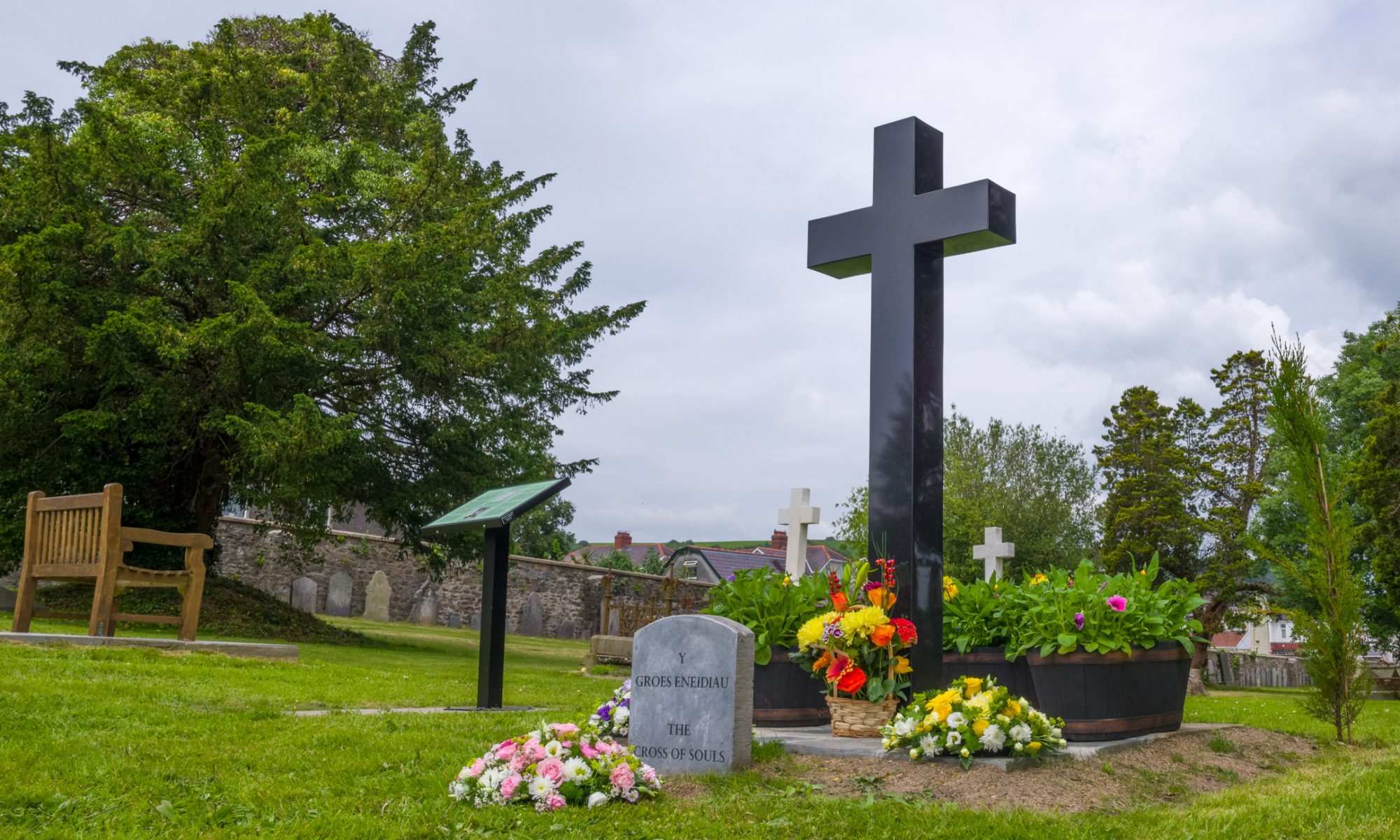
Unlike all the previous stories in this “What’s in a Name” series, this one is very special because it relates to St David’s Church itself encircled as it now is by almost six thousand burials. As with every single story so far published, all religious services, whether they be baptisms, weddings or funerals, St David’s church was always at the centre of it all, where everyone came to pay their respects and support the families concerned and in the relatively short time it remained a consecrated building, it was to see an unbelievable array of historical events that no one could ever have imagined possible. The following story therefore is so unique it had to be told. Here then is that story, I hope I do it justice.……………………………………..
Charles Jones, the currier, newspaper shareholder, Magistrate, and former Mayor of Carmarthen (1839–1840) and an ardent Wesleyan Methodist, died at his residence in Lammas Street Carmarthen on 31st October 1852 after a long illness. His wife Elizabeth predeceased him by some 20 years. Their Son Daniel Jones was born on 9th March 1808 and was baptised the following month – on the 9th April 1808 in St Peters Church Carmarthen. Alfred Lewis Jones – Daniel’s son and Charles’s grandson, was born in Picton Place Carmarthen in 1845, and was baptised in the newly built St David’s Church a few weeks later, the family home being a few minutes walk away. Alfred’s middle name of Lewis was his grandmothers maiden name. After a very full and active life, Charles Jones died on 31st October 1852 aged 74 and both his son Daniel and grandson Alfred attended his funeral at the Ebenezer Methodist Chapel in John Street, travelling down from Liverpool a few days previously. It would be the last time that they ever returned to Carmarthen. It seems extraordinary in some ways that the location of Charles’s last resting place cannot be established with any certainty as the burial records that still exist only go up to 1832, which are held by the National Library of Wales in Aberystwyth. Alfred himself was baptised in St David’s church on March 28th 1845, but who could have possibly known that by the end of the century – some fifty years later, Alfred would have become one of the richest men in the world and change the course of the treatment of tropical diseases forever, saving millions of lives in the process. Sadly, the original baptismal font was replaced during extensive renovation works to the church in 1886.
Sir Alfred Lewis Jones KCMG ( Knight Commander of the Most Distinguished Order of St Michael and St George ) was a highly influential businessman and shipping magnate who dominated the British maritime trade during the late 19th and early 20th centuries. Born in Carmarthen on 24 February 1845, the only son of Daniel Jones, proprietor of the Welshman newspaper, he became known as “The Uncrowned King of West Africa” due to his vast commercial empire.
Rise from Apprentice to Shipping Tycoon
Alfred’s family moved from Carmarthen to the major port city of Liverpool when he was just three years old and at the age of 12, he began working as a humble ship’s apprentice and cabin boy for the African Steamship Company. Through relentless work and sharp business acumen, he rose through the ranks. By 1890, he acquired a full controlling interest in Elder Dempster and Company, turning it into one of the largest shipping lines in the world. At the time of his death, his company controlled a massive fleet of 109 vessels.
Sir Alfred expanded his shipping operations into an all encompassing monopoly across West Africa and the Atlantic. He founded the First Bank of Nigeria (originally the Bank of British West Africa) in 1894 to control the financial systems supporting his trade routes and is widely credited with kickstarting the international tourist trade and the banana industry in the Canary Islands, utilising his fleet’s refrigerated holds to introduce bananas to the British public for the first time through his friendship with the Fyffe family. Canary Wharf in London was named after his shipping involvement. By the mid 1890s, Jones was not only the pre-eminent figure in the West African shipping trade but also had a dominant presence on land. In addition to his coastal and river services, Jones ran hotels, cold storage, victualling, chandlery, cartage, oil mills, collieries and other mines. Recognising that tropical diseases like malaria and yellow fever were devastating his ship crews and African workers, he funded and co-founded the Liverpool School of Tropical Medicine in 1898 – the first institution of its kind in the world, and which remains one of the most influential and important scientific institutions in existence in the treatment of tropical diseases.
Because he never married, he left the vast majority of his enormous fortune (estimated at £100,000,000 – one hundred million pounds) to charitable causes, education, and science when he died in 1909. Sir Alfred clearly took a genuine and deep interest in the well being of all those who lived in the countries which his ships traded, evidenced by his huge efforts to support their industries and address their health problems with the founding of the Hospital for Tropical Medicine in 1898. “HE WORKED THAT HE MIGHT GIVE” is inscribed on his headstone, typically referring to his philanthropy.
He was also one of the most decorated civilians ever, receiving honours and decorations from many heads of state including Belgium, Portugal, Liberia, France, and many others. In 1906, King Alfonso VIII of Spain conferred on him the Order of Isabella the Catholic in recognition of “the great services rendered by Sir Alfred in promoting agriculture in and generally developing the trade and commerce of the Canary Islands” In the same year, Jones had entertained the King of Spain on his visit to the Canaries. Also Tsar Nicholas II of Russia personally decorated him whilst visiting Cowes Regatta on the Isle of Wight in 1909.
Sir Alfred’s Memorial in Liverpool
The memorial is situated in Pier Head, a district at the centre of Liverpool’s mercantile business centre, where a collection of landmark buildings and memorials are located.
At the uppermost part of the memorial statue is the personification of the City of Liverpool, it is decorated with the city’s heraldic symbols and has a crown and tabard. She is holding a globe on which is balanced a small ship. Below, on either side, are two statues of women that depict Research and the Fruits of Industry, in view of Sir Alfred Lewis Jones’ introduction of the banana to Britain.
Below the bust length portrait, the plaque states “In memory of Sir Alfred Lewis Jones KCMG; a shipowner strenuous in business, he enlarged the commerce of his country by his mercantile enterprise and, as founder of the Liverpool School of Tropical Medicine, made science tributary in civilisation in Western Africa and the colonies of the British Empire.”
Having never married, Alfred’s eldest niece’s husband Owen Harrison Williams was the executor of his will. Williams took twenty years to finalise all of his huge estate. Many hundreds of individuals, charities and institutions would benefit from his will and continue to do so to this day, not least the Liverpool School of Tropical Medicine which remains one of the worlds foremost scientific research establishments. The remainder of his estate was turned into a charitable trust, which distributed millions of pounds to worthy causes. Alfred suggested to his trustees that his wealth be directed towards “the technical education of natives on the West Coast of Africa, original research into the cause of disease on that coast, the advancement of education of science, the relief of the poverty of any deserving person in the employ of any company in which he was interested” and the assistance of any charitable object which would benefit Liverpool or the West Coast of Africa. Alfred died on the 13th December 1909 aged just 64 and is buried in Anfield Cemetery, Liverpool.
All in all, not bad for a Carmarthen born boy, baptised here in St David’s Church, with close family links with the Town who died 119 years ago. I am sure his grandfather – Charles Jones, and his father Daniel would have been very proud of him. The following obituary of Alfred’s grandfather appeared in the Welshman newspaper on Friday November 5th 1852 . May they all rest in peace.
DIED. On the 31st ultimo, in the 74th year of his age, Mr. Alderman Charles Jones, currier, of Lammas Street, in this town. He bore his somewhat protracted and painful affliction with Christian patience, and died in blessed hope, exchanging sorrow for rest, and deeply regretted by his family and friends.


Credit: Wellcome Library, London.
1920 Liverpool school of tropical medicine : historical record 1898-1920.


