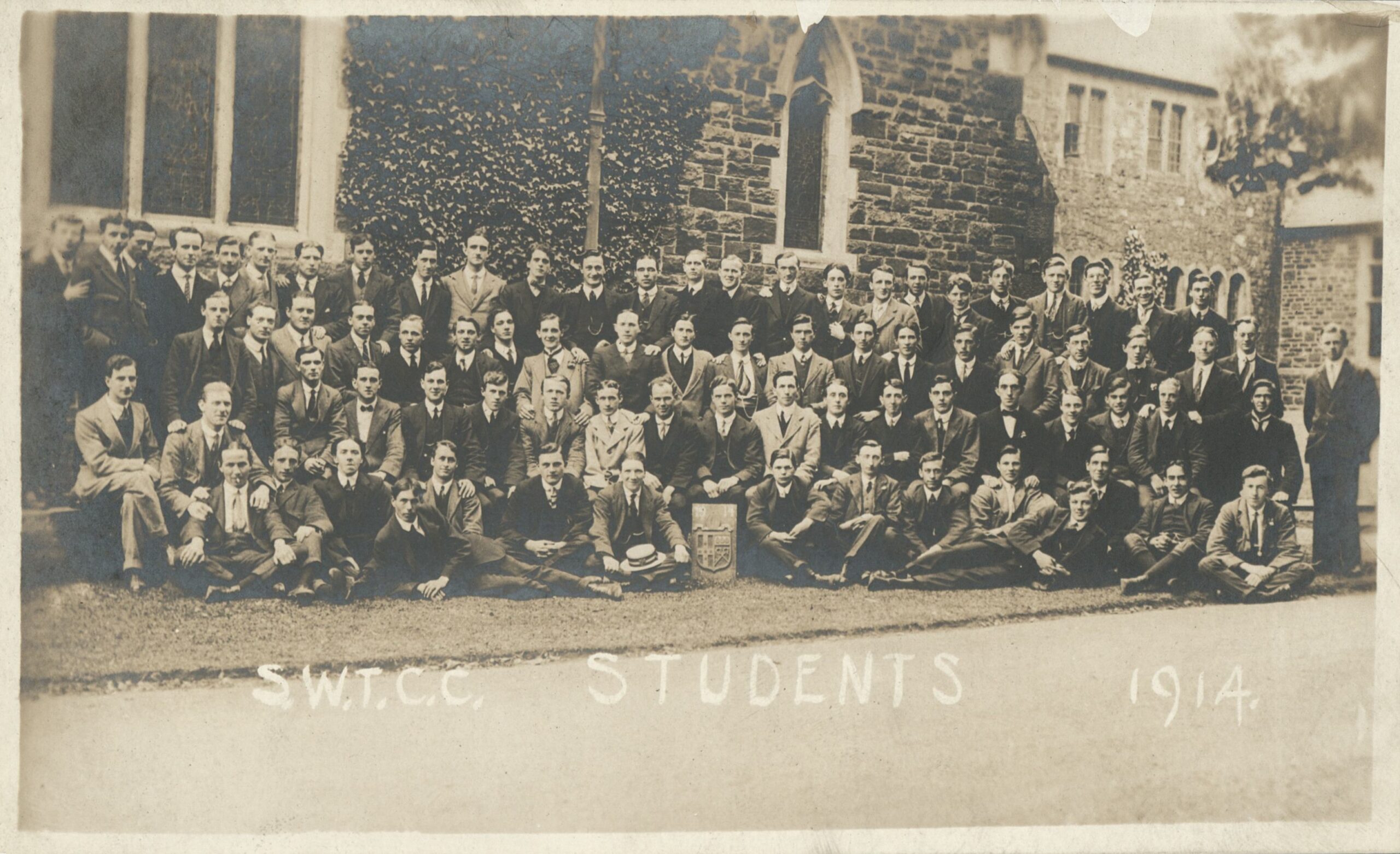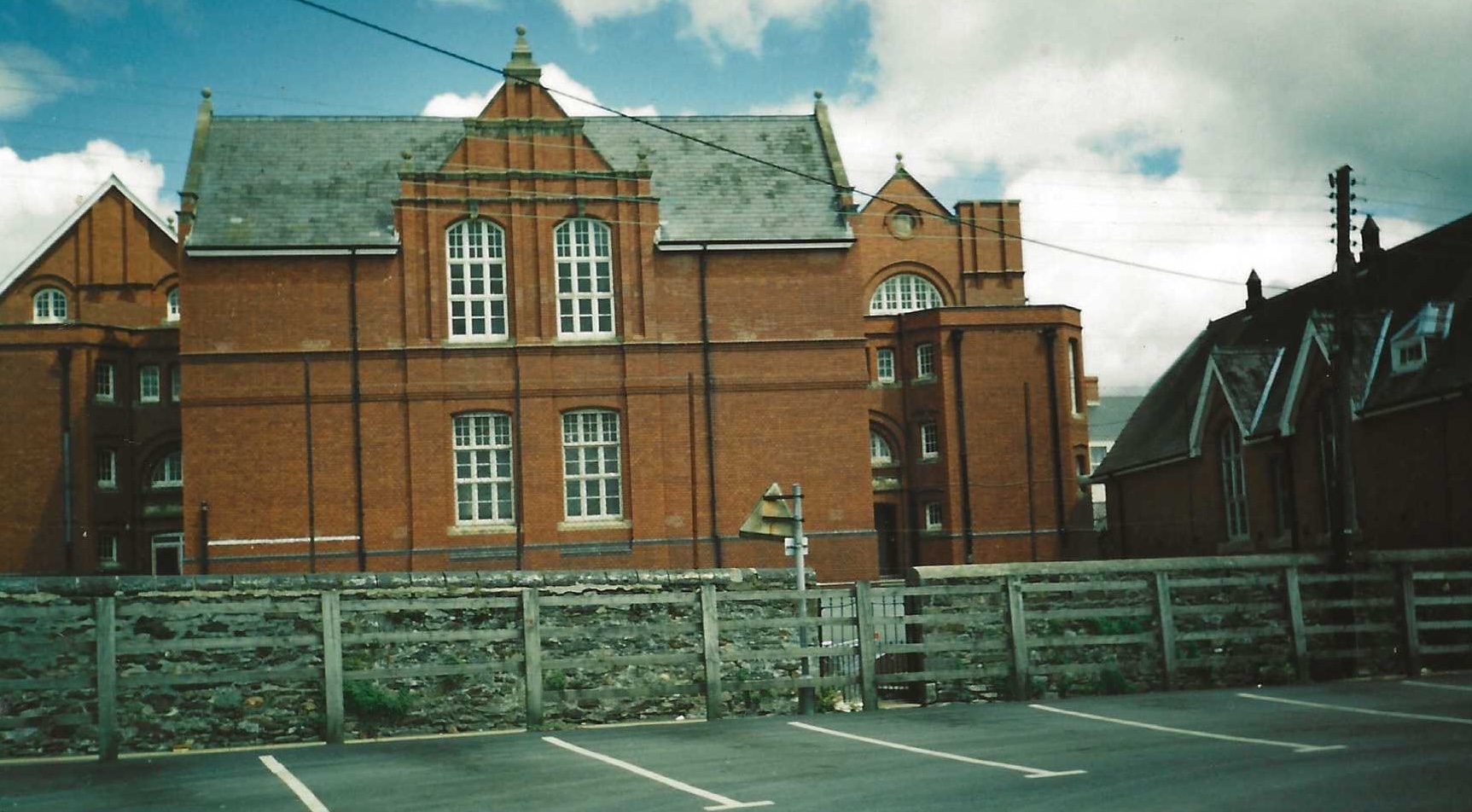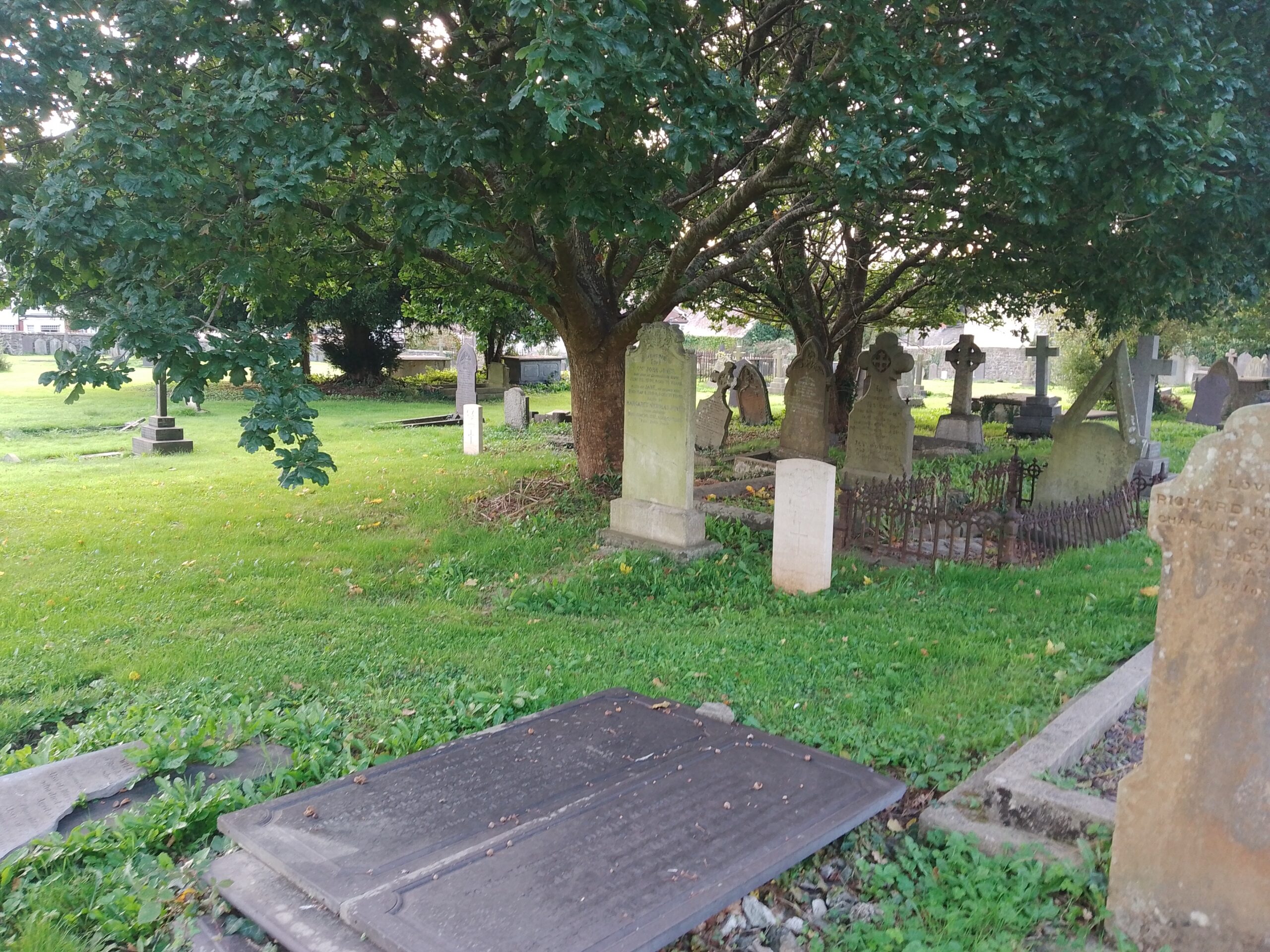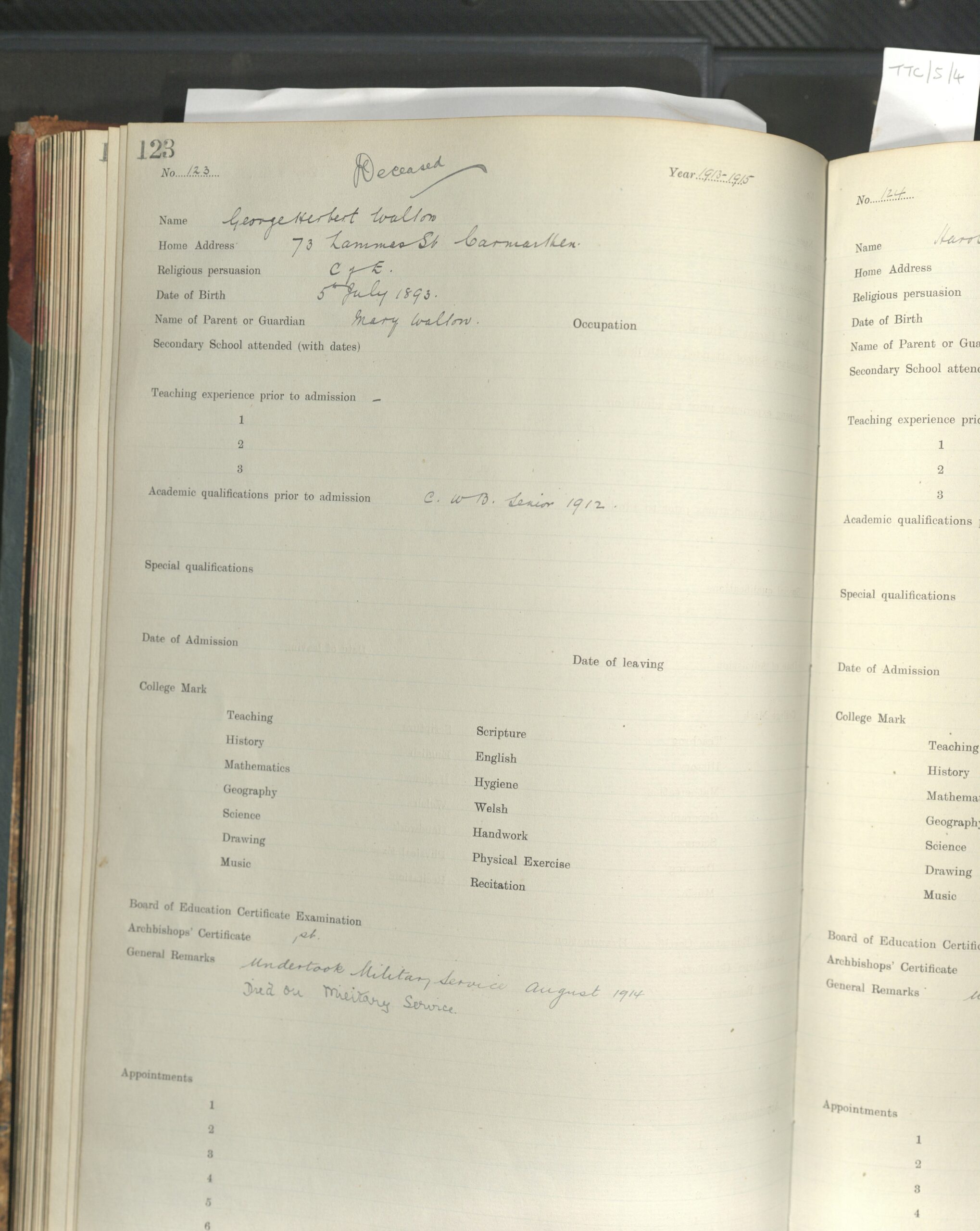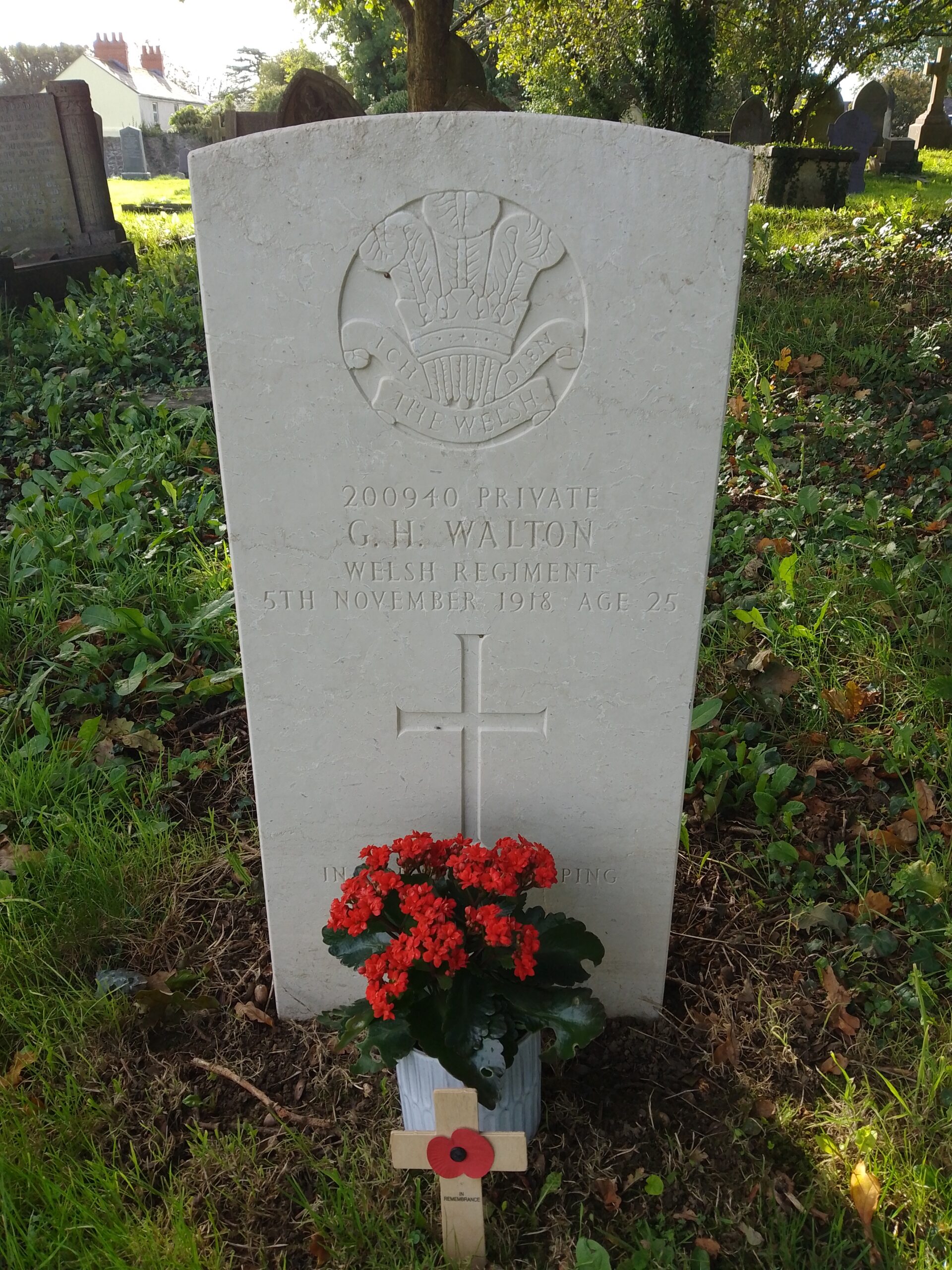
Remembrance weekend will soon be upon us and it is fitting I think to write a short story of young George Walton who entered into the halls of the then Teaching Training College here in Carmarthen in 1913 aged just 20, known then as the South Wales Training College ( now known as the world renowned Trinity St David’s University ) with the intention of qualifying as a teacher, only to succumb not to the horrors of the Great War, dying by shellfire on foreign soil, but at home in Lammas Street Carmarthen, to the influenza epidemic that swept Europe and beyond that killed millions of people – more than the Great War itself. Whilst George had every intention of “doing his duty” for King and Country he was classed as medically unfit in 1917 and never left these shores though he never forgot the friends he made in College that never came back from that terrible conflict. Nevertheless, a Commonwealth War Graves Commission headstone now marks the spot where George is buried, and quite rightly ALL such headstones are the same, however long they served and whether or not they embarked for service abroad or not.
George originally enlisted into the South Wales Training College own 4th Welsh College Company in 1913 which was mobilised in August 1914 at the outbreak of the Great War. However George became ill during what was quite a physically demanding course of military training and really never recovered from the rigours despite being a promising rugby player – he played in three games in 1913 against Gowerton, Aberystwyth and the Presbyterians. He also played in the college cricket team during the midsummer term 1914, just before he left the college and there is a description printed in the college’s own magazine at the time which says….
“The Season was started in a brilliant fashion, the team being credited with three successive wins. At Pontardulais we were unfortunate to lose by a margin of 9 runs, and since that time we have enjoyed but moderate success. There are elements of a good team representing the College this season, but external circumstances have interfered largely with practice. George Walton making his appearance in the First Eleven had had little opportunity of revealing his capabilities, but should make a really reliable bat. Fielding requires a little more care”
Reading through the Training College bound magazines for the period of 1911 onwards, the “innocence” of college life and the way everyone enjoyed themselves was very revealing and of course very sad, for as we know what was to become of them only a year or two later. In particular the “nicknames” that everyone was given was part of college life, – here are some mentioned, and you can draw your own conclusions as to why !
Dreamy, BO, Bulldog, Vinegar (whose surname was Sarson’s) Marbles, Bouncer, Father, Fidler, Jerry, Happy, Ponty, Spider, Smiler, Slogger, Pom Pom, Cockney, Martha, and three who stand out due to the written comment alongside their names
“Windbags” – “had a big say in the conversation as usual”
“Grasper” – “distinguished himself by eating a loaf of bread before breakfast”
“Lively” – “who as usual was only half awake”
Whatever happened to all these “characters” we will never know, but I hope that most of them did survive the Great War and lived to a ripe old age. However, they are all gone now and may they all rest in peace. The group photograph taken of all the College students in 1914 is a really emotive one, and somewhere amongst them is George Walton, Windbags, Lively and Grasper and all the others.
There is one noticeable error in the College Register which says that George “Died on Military Service” This is of course not correct as George was discharged as medically unfit in 1917. He fell seriously ill while stationed at a military camp in Dale, Pembrokeshire, and was medically discharged with a pension in September 1917. Prior to his untimely death in November 1918 he had been working as a teacher in Pentrepoeth School in Carmarthen for nine months.
Death Certificate meanings regarding George Walton.
Cardiac Displacement
A change in the normal position of the heart inside the chest caused by outside pressures or conditions in nearby organs caused by a large buildup of fluid in the space around the lungs pushes the heart to one side.
Lobar Pneumonia
Lobar pneumonia is a serious bacterial lung infection that causes inflammation and solid consolidation across a large, continuous section (lobe) of a lung.
Trinity students and the First World War – Student Soldiers
In 1911, students at Trinity College formed a half company of Territorials known as
‘E’ Company. A College Volunteer Corps had started in 1871, but was disbanded following friction between the student and local town voluntary corps. On one occasion during shooting practice, a student missed the target and hit and killed an unfortunate pig.
The new Territorials paraded twice a week and practised shooting on miniature and open ranges. A fortnight was spent at their first military camp at Porthfield in 1911, where they were drilled and taken on route marches and night manoeuvres. By 1912 ‘E’ Company consisted of sixty-six students and a separate signalling squad had been formed. Their activities were regularly reported in the College magazine, The Carmarthen, under the title ‘Territorial Notes’.
The regimented routine of college life, with its emphasis on academic and physical and domestic duties, ensured that the students were well equipped for military life and regarded camp as a ‘good fortnight’s holiday’. The report of the 1912 camp at Hereford is full of high jinks and absurd nicknames. The students took part in the Brigade ‘Marathon’ and won silver cups for ‘smartness and efficiency’ and the ‘most efficient sergeant in the battalion’. However, the comment, ‘Will we ever forget our fortnight’s wallowing in mud’, is a tragic foresight into the future of some of those students.
The ‘Territorial Notes’ of Midsummer 1914 is still full of innocence and fun. The ‘Terriers’ embarked on a route march to Ferryside, a ‘really enjoyable exercise’ which ended with ‘a very good tea’ and the train back to Carmarthen. By Christmas 1914 however, the tone is more serious. All students who were physically fit had joined ‘E’ Company which was mobilised in early August. They were marched thirteen miles from Milford to Dale, but this was not now an enjoyable lark,
The memories of that march still haunt some of us. More than one man marched whilst sleeping. Never did any welcome their destination more than we welcomed Dale. As soon as the Company was dismissed the great majority of us simply lay down on the ground and fell fast asleep.
From Dale the battalion was moved to Fort Scoveston in Milford Haven. Here they undertook intense physical training and were inoculated against typhoid and other illnesses. On November 5th the Company was sent to Swansea to protect the docks but were recalled to Fort Scoveston on the 15th to prepare for departure for foreign service. Their destination was unknown, but each ‘Carmarthenite’ was ready ‘to play his part, to the best of his ability, in that region of the world to which his country sends him.’
The ’Carmarthenites’ served throughout the world: France, Germany, India, Mesopotamia, Gallipoli, Egypt, Palestine, Sierra Leone, Macedonia, Turkey, Serbia, Bulgaria, Italy and Corfu.
They served in the RAF, the Navy and the Army as wireless operators, telegraphists, signallers, despatch riders, drill sergeants, anti-gas instructors and on minesweepers. One student served twice aboard vessels which were sunk, another joined the Welsh Guards and was wounded three times between 1915 and 1917. Another, serving with the R.W. Fusiliers was captured on the first day of the German March Offensive in 1918, and worked in German coal mines.
I am most grateful to Nicky Hammond BA (Hons), MA (Hons), PGDip Archivist at the University of Wales Trinity St David’s Campus in Lampeter for providing me with much of the material relating to this story.